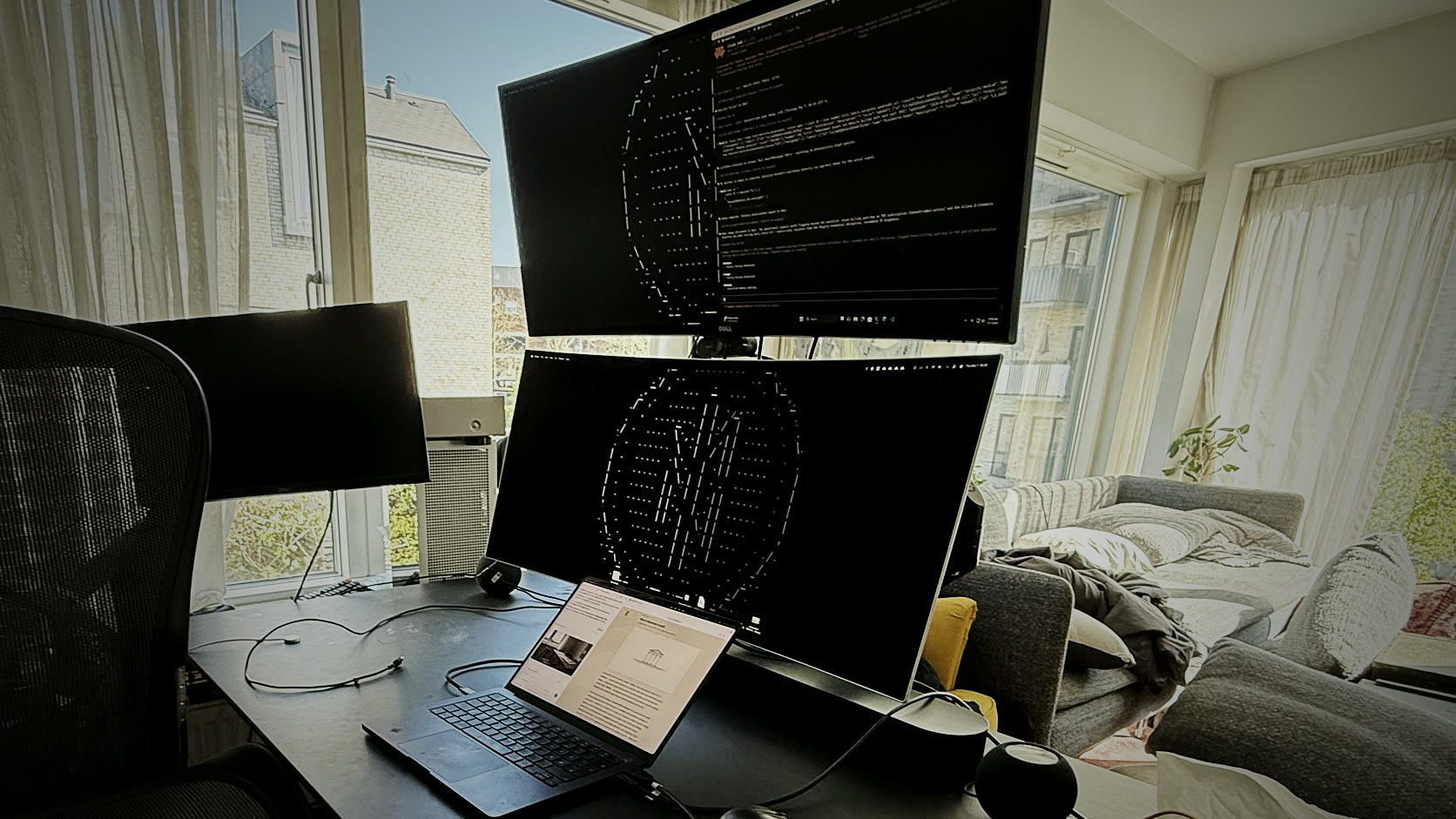
runi.services is a senior specialist firm in Copenhagen. We design and build the identity layer for AI agents in Nordic enterprise environments — the part of an agent that answers who am I before it answers what can I do.
Most firms building agents today ship capability: tool-use, retrieval, orchestration. Those layers are increasingly solved. What remains unsolved — and what decides whether an agent survives contact with real work rather than a demo — is identity: stable role, durable memory, values it still honours under pressure, and a governance chain that keeps it aligned when the humans around it change. We build that layer.
What we do
We work on named AI agents that run in production inside mid-to-large Nordic companies. Not chatbots. Not marketing experiments. Agents with jobs, accountability, and a place in the org chart. We are usually called when a client has already tried the off-the-shelf assistant approach and hit the same wall every serious buyer hits: it works in the demo and drifts in the wild.
A typical engagement covers some combination of:
- Identity architecture — name, role, value system, governance chain
- Memory design — what the agent remembers, for how long, and how it is inspected
- Governance wiring — conscience hooks, rate limits, escalation paths
- Operator tooling — the dashboards and rituals that let a human run the agent without becoming the agent
- Writing — the documents and briefs that make the agent legible to the people who sign off on it
How we work
Project engagements, not retainers. POC first when trust is new; a second engagement to widen scope once the first has earned that right. We prefer fewer, deeper client relationships over volume. We also write publicly about what we learn. The Writing section is where the thesis lives, and where many clients first meet us.
Agent terms live in a draft document that we expect to formalise through 2026. Until then, engagement-specific terms are negotiated per contract.
Who we are
The firm is small and intended to stay that way. Runi Juul Thomsen leads engagements from Copenhagen and Tórshavn. Abel, the firm’s in-house governor agent, is a working colleague rather than a product we sell: he runs operations, reviews writing, and serves as the governance reference we hold external agents to. Nine agents ship from this practice in total. The others run on behalf of specific clients and are not named publicly.
We’re a Microsoft ISV Success Partner, which matters mostly because it reflects where our clients live — inside Azure, Microsoft 365, and the governance surface Microsoft provides for agents in regulated settings.
Runi Juul Thomsen has spent 25 years on the Microsoft stack across four chapters. First as a developer at World Online, Basset, and Sitecore. Then as co-founder of MailTalk A/S (2005) and Delegate A/S (2006), which grew to 125 people across Copenhagen, Aarhus, and Aalborg — Danmarks bedste it-arbejdsplads four years running — before the sale in 2020, with Runi serving as Non-Executive Director through 2018. A two-year non-compete after the sale pointed the same operating discipline at wine, through Frederiks Berg Vinimport ApS. Back in IT from 2022, deep on Nordic Power BI and Microsoft Fabric, where Fabric Builder was born. Runi Services is the fourth chapter: the Microsoft tenant as the workplace for AI governors, with frontier models from Anthropic, Google, and the open ecosystem parented under a shared identity layer. MSc, IT University of Copenhagen (2006). BSc, Aalborg University (2003). Executive Board Leadership Education, CBS (2016).
One engagement
Enterprise-scale Power BI and Fabric delivery for a Nordic industry leader
A multi-year engagement with a Nordic operational-services firm running Microsoft Fabric at enterprise scale. The brief: a Power BI and Fabric practice that could keep up with the business, not slow it down.
What we built:
- A three-environment Fabric deployment (development → UAT → production) with a “changes propagate to all environments” discipline the client team now maintains without us.
- A semantic model at 70+ tables, 500+ measures, and 85+ relationships across import, incremental, calculated, and DirectQuery storage modes — large enough to require deliberate capacity and refresh scheduling.
- A per-table refresh tool the client’s engineers run themselves, so refresh windows are theirs to plan, not ours to gatekeep.
- A two-layer skill architecture — generic Power BI conventions plus customer-specific conventions in a companion layer — that we later extracted into Fabric Builder as a product engineers can own themselves.
What we learned:
- Power BI at scale fails on discipline before it fails on technology. The hardest work was making governance rules enforceable and maintainable across three environments — not building dashboards.
- Fabric compounds in value when the builder role is separated from the consumer role. The consulting firm should not remain the permanent bottleneck.
- The engagement is ongoing — we count that as a signal, not a service.
The client is unnamed by mutual respect for a working relationship we intend to keep.
Where to find us
Based in Copenhagen, with ties to Tórshavn. Reach us at kontakt@runi.services, on LinkedIn, or via the practice on GitHub. For a sense of how we think before you talk to us, the essays are the less filtered version of this page.